


Written by EsthetiCare Medical Content Team
- Medically reviewed by
Dr. Umair Hafeez, MBBS
Last reviewed: 10 September 2026

Hair loss can happen for many reasons, including genetics, hormonal changes, stress, nutritional deficiencies, certain medical conditions and age-related changes. The right treatment, therefore depends on why the hair is thinning, how advanced the loss is and whether the hair follicles are still active.
At Estheticare Clinic, hair loss treatment is planned according to the individual’s hair and scalp condition rather than using the same procedure for everyone. Depending on the assessment, options may include medication, PRP hair treatment, low-level laser therapy or hair transplant surgery.
If you are unsure which option is appropriate, a consultation with a qualified hair specialist can help identify the likely cause and discuss suitable treatment options.
Quick Facts
| Treatment aspect | What to know |
|---|---|
| Treatment options | Medication, PRP, laser therapy and hair transplant may be considered |
| Cost | Depends on the treatment, number of sessions and extent of hair loss |
| Downtime | Often minimal for non-surgical treatments; transplant recovery is longer |
| Results | Vary according to the cause of hair loss and treatment selected |
| Suitability | Determined after assessing the scalp, hair pattern and overall health |
| Consultation | A medical assessment can help determine the most appropriate approach |
What Is Hair Loss Treatment?
Hair loss treatment refers to medical and procedural approaches used to manage excessive shedding, thinning hair, receding hairlines and areas of reduced hair density.
There is no single treatment that works for every type of hair loss. For example, early pattern hair loss may be managed with non-surgical treatments, while someone with established areas of permanent follicle loss may be assessed for a hair transplant.
The first step is understanding the pattern and possible cause of the hair loss. Your specialist may consider your medical history, family history, scalp condition, pattern of thinning and the amount of healthy donor hair available.
What Causes Hair Loss?
Hair shedding can be temporary or progressive. Common causes include:
- Genetic or pattern hair loss
- Hormonal changes
- Stress and illness
- Nutritional deficiencies
- Certain medications
- Scalp disorders
- Autoimmune conditions
- Age-related changes
- Physical or emotional stress
- Some medical conditions
Because the causes are different, treating the visible hair loss without understanding the underlying problem may not provide the result you expect.
How Is Hair Loss Treated?
Treatment depends on the diagnosis, severity of hair loss and condition of the follicles.
1. Medication
Certain prescription or topical medications may help reduce shedding or support existing hair growth in appropriate patients.
Medication is not suitable for everyone, and a doctor should assess your medical history, current medicines and the likely cause of hair loss before recommending treatment.
2. PRP Hair Treatment
PRP uses a concentrated portion of your own blood and delivers it through injections into selected areas of the scalp.
It may be considered for people with thinning hair who still have viable follicles.
Learn more about PRP Hair Treatment in Dubai if you want to understand the procedure, expected timeline and possible side effects.
3. Laser Hair Therapy
Low-level laser therapy (LLLT) uses specific wavelengths of light to stimulate hair follicles and may be considered as a non-surgical option for certain types of hair thinning.
It is particularly relevant for patients looking for a treatment that does not involve injections or surgery.
Read our detailed guide to Laser Hair Therapy for Hair Loss to learn how the treatment works and who may benefit.
4. Hair Transplant
A hair transplant may be considered when there is sufficient healthy donor hair and the affected areas are suitable for surgical restoration.
During a transplant, follicles are taken from a donor area and placed into areas where additional density is needed.
If you are considering surgical restoration, you can learn more about FUE Hair Transplant in Dubai.
Which Hair Loss Treatment Is Right for You?
The most appropriate treatment depends on several factors rather than simply the amount of hair you have lost.
Your specialist may consider:
- The cause of hair loss
- Your age and medical history
- Whether the hair loss is temporary or progressive
- The pattern and severity of thinning
- Scalp health
- The condition of existing follicles
- Donor hair availability
- Your treatment goals
- Whether you prefer a non-surgical or surgical approach
For example, someone with early-stage thinning may be considered for a non-surgical approach, while a patient with established bald areas may require an assessment for hair transplantation.
In some cases, more than one treatment may be considered as part of a longer-term hair restoration plan.
Hair Loss Treatment vs Hair Transplant
Hair loss treatment and hair transplant are not necessarily the same thing.
Non-surgical treatments such as PRP or laser therapy generally aim to support existing follicles and manage thinning. A hair transplant physically moves healthy follicles into areas where additional coverage is required.
A transplant may therefore be more appropriate when follicles in a particular area have been permanently lost, while non-surgical treatment may be considered when viable follicles remain.
Your specialist can explain which approach is realistic after examining your hair and scalp.
Hair Loss Treatment Results
Results depend on the underlying cause, the treatment selected and the condition of the follicles.
Non-surgical treatments generally require patience because hair growth occurs gradually. Some patients may notice changes in shedding or hair quality before seeing a significant change in density.
Hair transplant results also develop gradually. Newly transplanted hair does not provide an immediate final result, and visible growth develops over several months.
It is important to have realistic expectations rather than expecting every treatment to produce the same outcome.


How Long Does Hair Loss Treatment Take?
Treatment time depends on the procedure.
A non-surgical session such as PRP or laser therapy may take less than an hour, although the exact duration varies.
Hair transplant surgery takes considerably longer and depends on the number of grafts and technique used.
The number of sessions also varies. Some treatments require a course of sessions followed by maintenance, while a transplant is generally performed as a surgical procedure followed by a longer growth period.
Hair Loss Treatment Recovery
Recovery depends on the treatment.
Non-surgical treatments usually involve little or no downtime, although temporary redness, tenderness or swelling can occur depending on the procedure.
Hair transplant surgery requires more aftercare while the scalp heals. Your surgical team will provide instructions regarding washing, physical activity, sleeping position and care of the treated area.
Following those instructions is important for proper healing.
Possible Side Effects
Potential side effects depend on the treatment selected.
Non-surgical procedures may cause temporary:
- Redness
- Tenderness
- Mild swelling
- Sensitivity
- Temporary irritation
Hair transplant surgery has different risks and recovery requirements, which should be discussed during the consultation.
If you experience unusual or persistent symptoms after treatment, contact your healthcare provider.
Hair Loss Treatment Cost in Dubai
The cost of hair loss treatment in Dubai varies considerably because there is no single procedure called “hair loss treatment.”
The final price may depend on:
- Treatment type
- Number of sessions
- Extent of hair loss
- Area being treated
- Number of grafts required for a transplant
- Technique selected
- Individual treatment plan
For this reason, a consultation is more useful than quoting one price for every patient.
If you are specifically comparing surgical options, see our Hair Transplant Cost in Dubai guide.
Why a Hair and Scalp Assessment Matters
Hair loss can look similar from the outside ehttps://chatgpt.com/en/hair-transplant/cost-of-hair-transplant/ven when the underlying causes are different.
A specialist assessment can help determine whether the problem is related to pattern hair loss, temporary shedding, scalp health or another factor.
This is particularly important when hair loss is sudden, occurs in patches, is accompanied by scalp symptoms or progresses rapidly.
FAQs About Hair Loss Treatment
What are Hair Loss Treatment options?
Hair Loss Treatment options include PRP, medications, FUE, DHI, and other customized hair restoration procedures.
How much does Hair Loss Treatment cost?
Hair Loss Treatment cost varies according to the procedure, number of sessions, and individual hair restoration needs.
Is Hair Loss Treatment suitable for baldness?
Hair Loss Treatment options depend on the extent of baldness, with transplantation considered for suitable candidates.
What age is best for Hair Loss Treatment?
The ideal time for Hair Loss Treatment depends on the cause and stability of your hair loss.
Our Medical Team
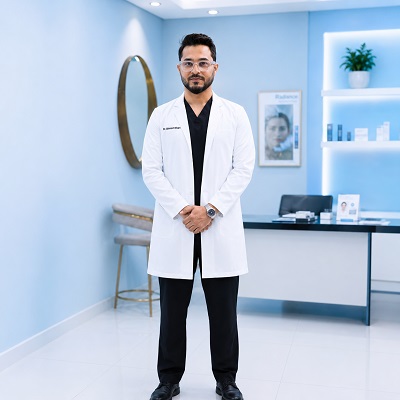
Dr. Umair Hafeez

Dr. Umair Hafeez is a highly skilled and compassionate Aesthetic Physician with extensive experience in advanced skincare, cosmetic dermatology, and...
View Profile Dr. Humair Nasir
Meet Dr. Humair Nasir, a highly experienced aesthetic physician specializing in advanced non-surgical cosmetic treatments. He is known for his expertise..
View Profile
Dr. Shazia Kalam
Dr. Shaziya Kalam is a well-reputed dermatologist who is well-focused on this particular area of dermatology where she has immense...
View Profile
Dr. Kamel Hassan
Dr. Kamel Hassan is a family medicine specialist and aesthetic medicine expert practicing in the United Arab Emirates. With more...
View ProfileThe clinic’s medical content is currently reviewed by Dr. Umair Hafeez, Aesthetic Specialist, MBBS, a DHA & MOH licensed aesthetic physician with experience in facial aesthetics, laser treatments and skin rejuvenation.
Treatment suitability should always be assessed by a qualified medical professional based on the patient’s individual condition.
Book a Hair Loss Consultation in Dubai
If you are concerned about thinning hair, excessive shedding or a receding hairline, the first step is to understand what is causing it.
Estheticare Clinic can assess your hair and scalp and discuss treatment options based on your individual needs.
Book a consultation to discuss your hair loss concerns with the medical team.